
Wine tourism is now a core revenue stream for wineries worldwide. This guide covers where the operational gaps are, what AI communication tools actually do, and how to implement them without losing the human element that makes a winery visit worth having.
The state of wine tourism in 2025
Wine tourism has moved from a niche offering to a structural pillar of winery economics. According to the Global Wine Tourism Report 2025 — the most comprehensive study to date, based on responses from 1,310 wineries across 47 countries, conducted by Hochschule Geisenheim University in collaboration with UN Tourism, OIV, and the Great Wine Capitals Global Network — wine tourism now accounts for an average of 25% of total winery revenue. Two out of three wineries report that their wine tourism business is profitable or very profitable.
Europe is the strongest-performing region: 43% of European wineries reported visitor growth over the past year, compared to 28% of wineries overseas. Only 17% of European wineries reported a decline in visitors — against 41% in overseas markets.
The global wine tourism market was valued at USD 108.3 billion in 2025 and is projected to reach USD 358.6 billion by 2035, at a CAGR of 12.7%.
The demand is real, the growth is confirmed, and the economics are compelling. The challenge is operational — specifically, how wineries with small teams manage the communication volume that comes with running a hospitality business alongside a production business.
Europe is the strongest-performing region: 43% of European wineries reported visitor growth over the past year, compared to 28% of wineries overseas. Only 17% of European wineries reported a decline in visitors — against 41% in overseas markets.
The global wine tourism market was valued at USD 108.3 billion in 2025 and is projected to reach USD 358.6 billion by 2035, at a CAGR of 12.7%.
The demand is real, the growth is confirmed, and the economics are compelling. The challenge is operational — specifically, how wineries with small teams manage the communication volume that comes with running a hospitality business alongside a production business.
The structural tension every winery faces
Running a winery means running two businesses simultaneously: producing wine and welcoming guests. These two activities compete for the same resource — time and attention of a typically small, often family-based team.
The Global Wine Tourism Report 2025 identifies the key challenges wineries face as they scale tourism: staffing shortages, the demands of digital transformation, and changing visitor expectations — particularly among the 25–44 age group, which is now the fastest-growing wine tourist segment, drawn to experiences that combine education, gastronomy, and authenticity.
Younger visitors in particular arrive with high expectations for digital responsiveness: they find wineries on Instagram, they send WhatsApp messages to ask about availability, they expect a reply before they commit. The winery that replies first — in their language, at any hour — is the one that gets the booking.
The problem is not willingness. It is capacity. During harvest, during tasting sessions, during the peak of summer — the team that would answer messages is the same team pouring wine, leading tours, and managing the cellar.
The Global Wine Tourism Report 2025 identifies the key challenges wineries face as they scale tourism: staffing shortages, the demands of digital transformation, and changing visitor expectations — particularly among the 25–44 age group, which is now the fastest-growing wine tourist segment, drawn to experiences that combine education, gastronomy, and authenticity.
Younger visitors in particular arrive with high expectations for digital responsiveness: they find wineries on Instagram, they send WhatsApp messages to ask about availability, they expect a reply before they commit. The winery that replies first — in their language, at any hour — is the one that gets the booking.
The problem is not willingness. It is capacity. During harvest, during tasting sessions, during the peak of summer — the team that would answer messages is the same team pouring wine, leading tours, and managing the cellar.
Where bookings are lost
The Global Wine Tourism Report 2025 explicitly identifies booking friction as a structural issue: many wineries still rely on emails or phone calls to manage reservations. For international visitors, this creates friction and often results in lost bookings.
Here is how it typically unfolds:
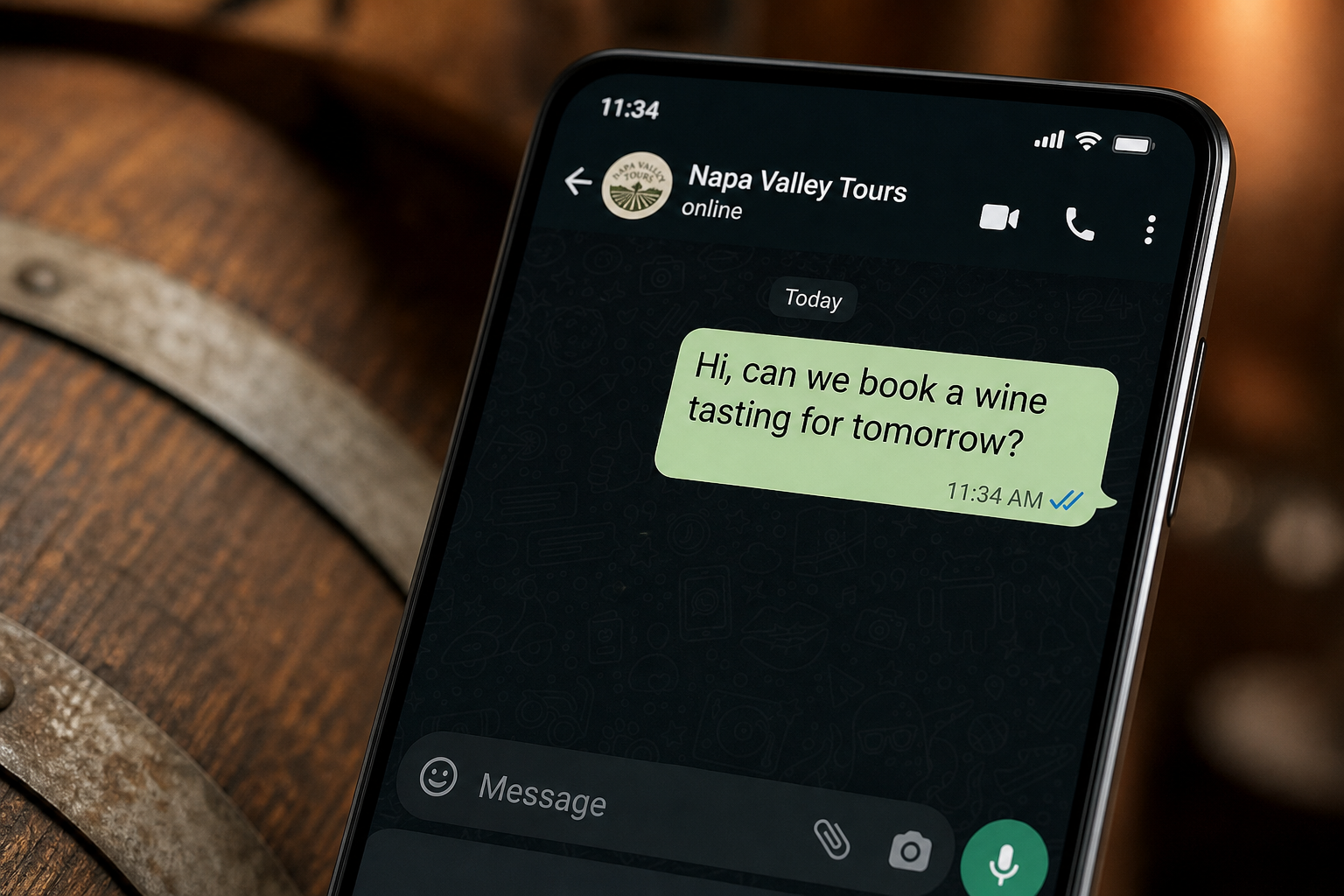
A couple from Germany is planning a trip to Tuscany, Burgundy, or the Douro Valley. They find a winery on Instagram, check the website, and send a WhatsApp message asking about tasting availability for the following Saturday. It is Thursday evening.
The winery owner is in the cellar. The message is seen on Friday morning. By then, the couple has already booked with a winery that replied the same evening.
The booking was never logged. The loss was never measured. But it happened — and it happens consistently, across every wine region, every weekend, every peak season.
Research by InsideSales.com and the Kellogg School of Management — based on analysis of 100,000+ customer inquiries — found that responding within five minutes makes a business 21x more likely to convert an inquiry. Waiting just ten minutes drops that probability by 400%. For a winery team that is managing visitors, production, and administration simultaneously, a five-minute response window is structurally impossible without some form of automation.
Here is how it typically unfolds:
A couple from Germany is planning a trip to Tuscany, Burgundy, or the Douro Valley. They find a winery on Instagram, check the website, and send a WhatsApp message asking about tasting availability for the following Saturday. It is Thursday evening.
The winery owner is in the cellar. The message is seen on Friday morning. By then, the couple has already booked with a winery that replied the same evening.
The booking was never logged. The loss was never measured. But it happened — and it happens consistently, across every wine region, every weekend, every peak season.
Research by InsideSales.com and the Kellogg School of Management — based on analysis of 100,000+ customer inquiries — found that responding within five minutes makes a business 21x more likely to convert an inquiry. Waiting just ten minutes drops that probability by 400%. For a winery team that is managing visitors, production, and administration simultaneously, a five-minute response window is structurally impossible without some form of automation.
What AI communication tools actually do for wineries
An AI assistant for a winery is not a customer service chatbot in the conventional sense. It is a system trained specifically on your property — your wines, your experiences, your availability, your policies — that handles the conversational layer of guest communication across the channels where your visitors already are: WhatsApp, your website, Instagram DM, email.
In practice, it handles:
Before the visit:
— Answers questions about tasting formats, prices, duration, what to expect
— Checks availability and confirms bookings, sends payment requests where required
— Communicates in the guest's language — German, French, English, Dutch, Japanese — without staff involvement
— Sends confirmation and reminder messages automatically
During peak season:
— Manages multiple simultaneous inquiries without delays
— Handles the questions that repeat every day: "Can we bring children?" "Is there parking?" "Do you offer vegetarian options at the pairing?"
— Escalates unusual requests — large groups, accessibility needs, custom experiences — to the team with full context
After the visit:
— Follows up with a personalised message
— Requests a review on Google or TripAdvisor
— Shares a link to purchase wines online or book the next visit
Upselling naturally:
When a guest asks about a standard tasting, the assistant can mention the premium experience — the vertical tasting, the harvest participation, the private cellar tour — at the right moment in the conversation. Not as a hard sell, but as genuinely useful information for someone who is already interested.
In practice, it handles:
Before the visit:
— Answers questions about tasting formats, prices, duration, what to expect
— Checks availability and confirms bookings, sends payment requests where required
— Communicates in the guest's language — German, French, English, Dutch, Japanese — without staff involvement
— Sends confirmation and reminder messages automatically
During peak season:
— Manages multiple simultaneous inquiries without delays
— Handles the questions that repeat every day: "Can we bring children?" "Is there parking?" "Do you offer vegetarian options at the pairing?"
— Escalates unusual requests — large groups, accessibility needs, custom experiences — to the team with full context
After the visit:
— Follows up with a personalised message
— Requests a review on Google or TripAdvisor
— Shares a link to purchase wines online or book the next visit
Upselling naturally:
When a guest asks about a standard tasting, the assistant can mention the premium experience — the vertical tasting, the harvest participation, the private cellar tour — at the right moment in the conversation. Not as a hard sell, but as genuinely useful information for someone who is already interested.
The multilingual dimension
Wine tourism is inherently international. According to the Global Wine Tourism Report 2025, while domestic tourists represent 65% of visitors at the median winery, the most commercially significant guests are often international — and they arrive from markets that don't share your language.
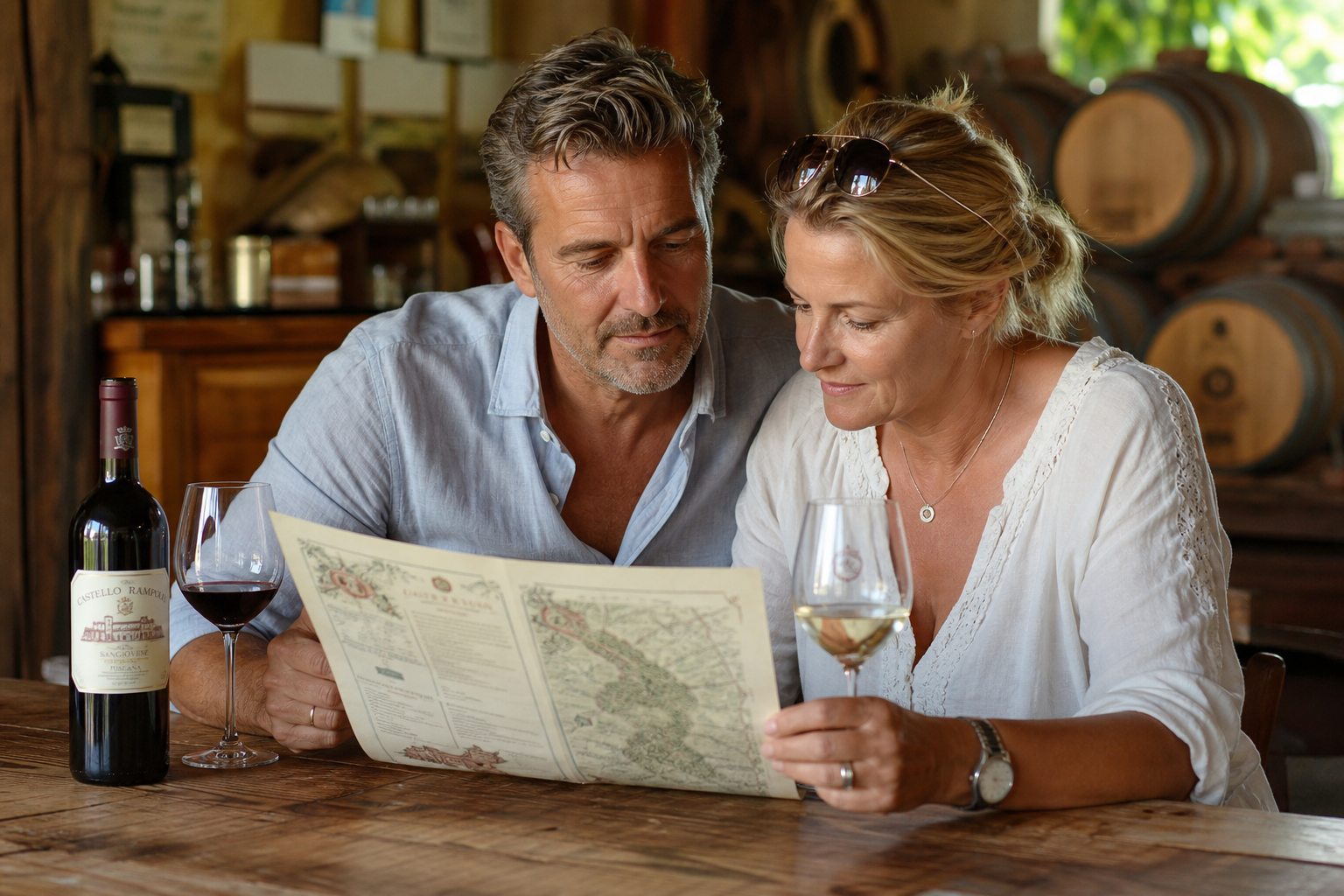
In Italy, France, Spain, and Portugal, the top inbound tourist markets include Germany, the UK, the US, the Netherlands, and increasingly Japan and China. A German couple planning a Tuscany trip, a Dutch family driving through Burgundy, an American honeymooning in the Douro — they all reach out in their own language, and they all expect a reply that feels natural, not translated.
An AI assistant that handles 150+ languages ensures that no inquiry is lost to a language gap. The first reply — the one that determines whether the conversation continues — arrives in the guest's language, immediately, regardless of the hour.
In Italy, France, Spain, and Portugal, the top inbound tourist markets include Germany, the UK, the US, the Netherlands, and increasingly Japan and China. A German couple planning a Tuscany trip, a Dutch family driving through Burgundy, an American honeymooning in the Douro — they all reach out in their own language, and they all expect a reply that feels natural, not translated.
An AI assistant that handles 150+ languages ensures that no inquiry is lost to a language gap. The first reply — the one that determines whether the conversation continues — arrives in the guest's language, immediately, regardless of the hour.
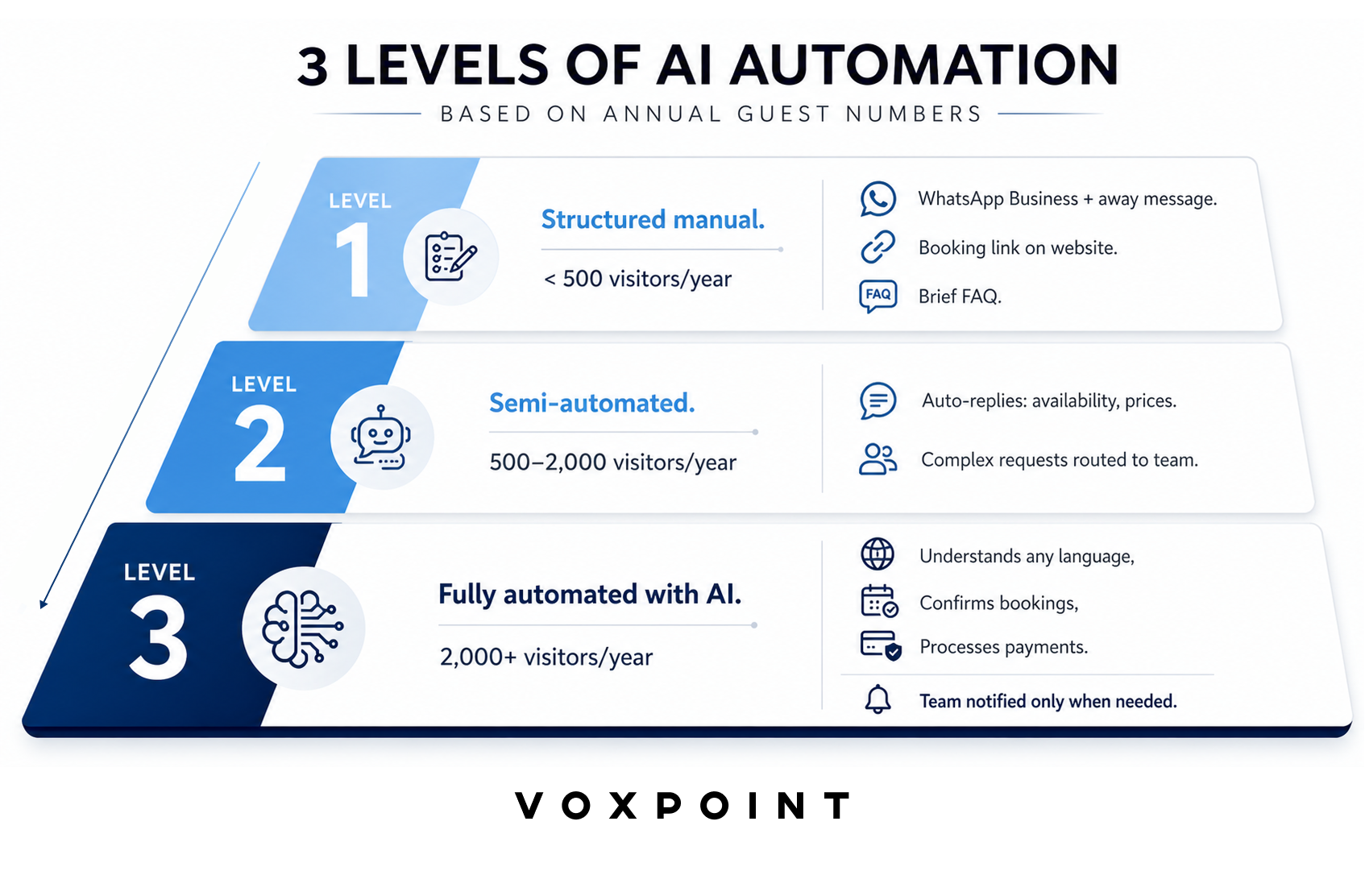
Three levels of implementation
Not every winery needs the same level of automation. Here is a practical framework based on visitor volume and team size:
Level 1 — Structured manual (fewer than 500 visitors/year)
Set up WhatsApp Business with an away message, a clear booking link, and a brief FAQ on your website. This doesn't resolve response time gaps, but it gives guests an alternative path when no one is available. Low cost, immediate to implement.
Level 2 — Semi-automated (500–2,000 visitors/year)
Configure automated responses for the most common inquiry types — availability, tasting formats, prices, location, opening hours. Complex requests are routed to the team. This handles the majority of routine volume during peak season without requiring staff attention for every message.
Level 3 — Fully automated with AI (2,000+ visitors/year, or strong international demand)
An AI assistant trained on your winery handles the full conversation: understands the request in any language, checks availability, confirms the booking, processes payment if required, sends reminders, and follows up post-visit. The team is notified only when something requires their direct involvement. This is the approach that makes sense for wineries operating at scale, or for smaller properties with strong international demand and limited staff.
Level 1 — Structured manual (fewer than 500 visitors/year)
Set up WhatsApp Business with an away message, a clear booking link, and a brief FAQ on your website. This doesn't resolve response time gaps, but it gives guests an alternative path when no one is available. Low cost, immediate to implement.
Level 2 — Semi-automated (500–2,000 visitors/year)
Configure automated responses for the most common inquiry types — availability, tasting formats, prices, location, opening hours. Complex requests are routed to the team. This handles the majority of routine volume during peak season without requiring staff attention for every message.
Level 3 — Fully automated with AI (2,000+ visitors/year, or strong international demand)
An AI assistant trained on your winery handles the full conversation: understands the request in any language, checks availability, confirms the booking, processes payment if required, sends reminders, and follows up post-visit. The team is notified only when something requires their direct involvement. This is the approach that makes sense for wineries operating at scale, or for smaller properties with strong international demand and limited staff.
What the assistant needs to know
Configuration matters more than technology. A well-trained assistant for a winery needs:
— Your experiences and availability — connected to your booking calendar in real time, so it never confirms a slot that doesn't exist
— Your wines — varieties, vintages, tasting notes, production methods, certifications
— Your visit policies — minimum booking size, age restrictions, cancellation terms, deposit requirements
— Your tone — a family estate in Piedmont and a design-forward winery in Provence are different conversations; the assistant should reflect your identity
— An escalation path — a clear rule for when to hand off to a human: custom requests, complaints, large group logistics, anything that requires discretion
The assistant does not need to handle everything. It needs to handle the right things — and know exactly where its limits are.
— Your experiences and availability — connected to your booking calendar in real time, so it never confirms a slot that doesn't exist
— Your wines — varieties, vintages, tasting notes, production methods, certifications
— Your visit policies — minimum booking size, age restrictions, cancellation terms, deposit requirements
— Your tone — a family estate in Piedmont and a design-forward winery in Provence are different conversations; the assistant should reflect your identity
— An escalation path — a clear rule for when to hand off to a human: custom requests, complaints, large group logistics, anything that requires discretion
The assistant does not need to handle everything. It needs to handle the right things — and know exactly where its limits are.
The bottom line
Wine tourism is growing. The visitors are coming. The question is not whether to invest in the experience — most wineries already have. The question is whether the communication infrastructure around that experience matches the quality of what guests find when they arrive.
A booking lost to an unanswered WhatsApp message on a Thursday evening is not a marketing failure. It is an operational one — and it is one of the most straightforward problems in hospitality to solve.
The winemaker's time is best spent in the cellar and with guests. An AI assistant takes care of the inbox so that time is protected.
A booking lost to an unanswered WhatsApp message on a Thursday evening is not a marketing failure. It is an operational one — and it is one of the most straightforward problems in hospitality to solve.
The winemaker's time is best spent in the cellar and with guests. An AI assistant takes care of the inbox so that time is protected.
Sources
- Global Wine Tourism Report 2025 — Hochschule Geisenheim University, UN Tourism, OIV, Great Wine Capitals Global Network (October 2025)
- The Drinks Business — Wine tourism now accounts for a quarter of global winery revenue (October 2025)
- Future Market Insights — Wine Tourism Market Size & Trends 2025 to 2035 (June 2025)
- European Commission / Transition Pathways — New Global Wine Tourism Report offers in-depth insights for Europe's wineries (July 2025)
- Movimento Turismo del Vino & Ceseo-Università Lumsa — Indagine Enoturismo Italia 2025, presented at Vinitaly Tourism, Verona (April 2026)
- InsideSales.com & Kellogg School of Management — Lead Response Management Study