
Europe's hotel sector is posting record numbers. This guide covers the operational gap between guest demand and team capacity — and what AI communication tools can do to close it.
The market context
EU tourism nights reached a record 3.08 billion in 2025 — an increase of 61.5 million over the previous year, driven primarily by international guests, who accounted for 49% of all overnight stays. Hotels and similar accommodation recorded 1.9 billion nights, representing 63% of total EU tourist nights.
The Europe boutique hotel market generated USD 8.19 billion in revenue in 2024 and is projected to reach USD 12.1 billion by 2030, growing at a CAGR of 6.8%. Europe accounts for 30.7% of the global boutique hotel market.
For independent properties — boutique hotels, B&Bs, agriturismi — this growth is an opportunity. It is also an operational challenge. International guests now represent nearly half of all overnight stays across the EU, and they arrive from markets that don't share your language, your time zone, or your working hours.
The Europe boutique hotel market generated USD 8.19 billion in revenue in 2024 and is projected to reach USD 12.1 billion by 2030, growing at a CAGR of 6.8%. Europe accounts for 30.7% of the global boutique hotel market.
For independent properties — boutique hotels, B&Bs, agriturismi — this growth is an opportunity. It is also an operational challenge. International guests now represent nearly half of all overnight stays across the EU, and they arrive from markets that don't share your language, your time zone, or your working hours.
The direct booking advantage
According to SiteMinder's Hotel Booking Trends report — based on analysis of 135 million reservations across 44,500+ hotel customers — hotel websites generated an average of USD 516 per booking in 2025, the highest value of any channel. This is more than 60% above the value-per-booking via OTAs (USD 320).
Direct booking revenue share remained stable in 2025, within 1.5 percentage points of the prior year across 95% of markets — despite predictions that AI-powered search would either erode or amplify the channel.
The implication is clear: guests who book directly spend more. They choose higher-value rooms, stay longer, and add extras. For an independent boutique hotel or B&B, protecting and growing the direct channel is one of the highest-return investments available.
The barrier to direct bookings is rarely price. It is most often friction — and specifically, the friction created when a guest reaches out with a question and doesn't receive a timely reply.
Direct booking revenue share remained stable in 2025, within 1.5 percentage points of the prior year across 95% of markets — despite predictions that AI-powered search would either erode or amplify the channel.
The implication is clear: guests who book directly spend more. They choose higher-value rooms, stay longer, and add extras. For an independent boutique hotel or B&B, protecting and growing the direct channel is one of the highest-return investments available.
The barrier to direct bookings is rarely price. It is most often friction — and specifically, the friction created when a guest reaches out with a question and doesn't receive a timely reply.

The operational gap
Independent hotels operate with lean teams. A 15-room B&B might have two or three people managing check-in, breakfast, housekeeping, and guest communication simultaneously. A boutique hotel with 30 rooms may have a small front desk team covering shifts that don't extend to midnight.
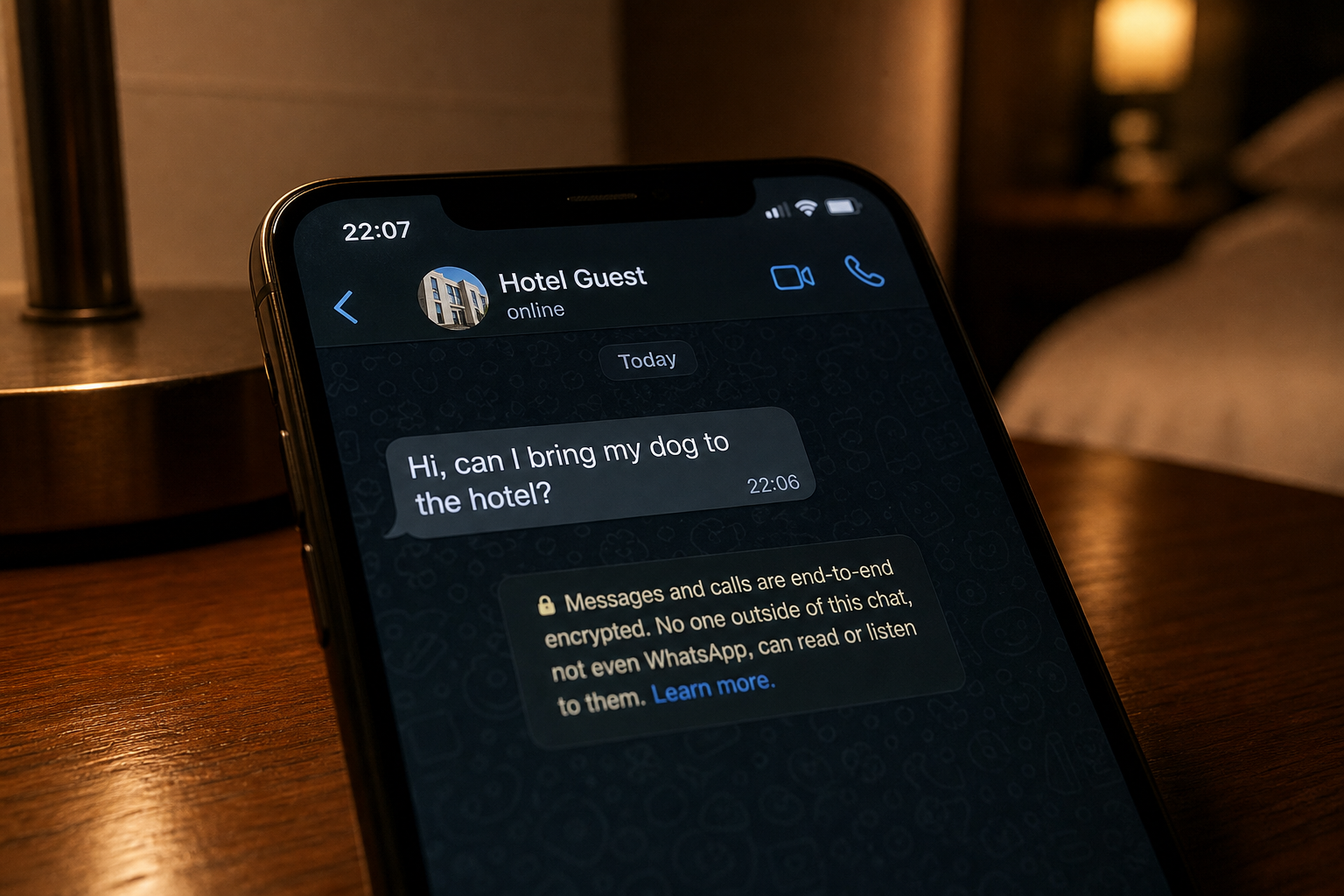
The hours when guests are most likely to send pre-booking inquiries — evenings, weekends, public holidays — are precisely the hours when the team is least available to respond. A guest browsing your property at 10 PM on a Sunday, ready to commit, has one question before booking. If no one answers until Monday morning, the decision has already been made.
As Phocuswright notes in Travel Forward 2026: "Hotels must work effectively with third parties that can integrate AI connectivity into their own systems" — the ability to respond at any hour, across any channel, is becoming a baseline expectation rather than a differentiator.
Research by InsideSales.com and the Kellogg School of Management — based on analysis of 100,000+ customer inquiries — found that responding within five minutes makes a business 21x more likely to convert an inquiry. Waiting just ten minutes drops that probability by 400%.
The hours when guests are most likely to send pre-booking inquiries — evenings, weekends, public holidays — are precisely the hours when the team is least available to respond. A guest browsing your property at 10 PM on a Sunday, ready to commit, has one question before booking. If no one answers until Monday morning, the decision has already been made.
As Phocuswright notes in Travel Forward 2026: "Hotels must work effectively with third parties that can integrate AI connectivity into their own systems" — the ability to respond at any hour, across any channel, is becoming a baseline expectation rather than a differentiator.
Research by InsideSales.com and the Kellogg School of Management — based on analysis of 100,000+ customer inquiries — found that responding within five minutes makes a business 21x more likely to convert an inquiry. Waiting just ten minutes drops that probability by 400%.
What AI guest communication tools actually do
An AI assistant for a boutique hotel or B&B is a system trained specifically on your property — your rooms, your services, your policies, your local area — that handles the conversational layer of guest communication across WhatsApp, your website, Instagram DM, and email.
Before arrival:
— Answers questions about rooms, rates, amenities, check-in procedures, parking, breakfast
— Manages direct booking inquiries, checks availability in real time, confirms reservations
— Offers upgrades and add-ons — early check-in, room with a view, spa booking, local tours — at the right moment in the conversation
— Sends confirmation and pre-arrival information automatically
— Communicates in 150+ languages, covering the full range of international guests
During the stay:
— Handles in-stay requests: restaurant recommendations, local transport, late checkout, housekeeping scheduling
— Routes complex or sensitive situations — complaints, special needs, anything requiring discretion — to staff with full context already captured
After checkout:
— Follows up with a personalised message
— Requests a review on Google or TripAdvisor
— Shares a direct booking link for the guest's next visit, reinforcing the direct channel
On upselling:
An AI assistant creates upsell opportunities that manual processes consistently miss. When a guest confirms a standard room, the assistant can mention the suite with a garden view. When someone asks about breakfast, it can offer the upgrade to include a wine tasting at a local producer. These offers feel helpful rather than pushy because they arrive in context — as part of an ongoing conversation, not as a generic promotional message.
Before arrival:
— Answers questions about rooms, rates, amenities, check-in procedures, parking, breakfast
— Manages direct booking inquiries, checks availability in real time, confirms reservations
— Offers upgrades and add-ons — early check-in, room with a view, spa booking, local tours — at the right moment in the conversation
— Sends confirmation and pre-arrival information automatically
— Communicates in 150+ languages, covering the full range of international guests
During the stay:
— Handles in-stay requests: restaurant recommendations, local transport, late checkout, housekeeping scheduling
— Routes complex or sensitive situations — complaints, special needs, anything requiring discretion — to staff with full context already captured
After checkout:
— Follows up with a personalised message
— Requests a review on Google or TripAdvisor
— Shares a direct booking link for the guest's next visit, reinforcing the direct channel
On upselling:
An AI assistant creates upsell opportunities that manual processes consistently miss. When a guest confirms a standard room, the assistant can mention the suite with a garden view. When someone asks about breakfast, it can offer the upgrade to include a wine tasting at a local producer. These offers feel helpful rather than pushy because they arrive in context — as part of an ongoing conversation, not as a generic promotional message.

The multilingual dimension
International guests accounted for 49% of all EU overnight stays in 2025 — and the share is significantly higher in Southern European destinations. For a boutique hotel in Tuscany, Provence, or the Algarve, the majority of guests in peak season may be arriving from Germany, France, the UK, the Netherlands, or the US.
They reach out in their language. A WhatsApp message in Dutch, a late-night inquiry in German, a booking request in French from a couple planning their anniversary trip — these are not edge cases. They are the daily reality of running a hospitality business in Europe's most visited regions.
An AI assistant handles 150+ languages natively. The first reply — the one that determines whether the conversation continues — arrives in the guest's language, immediately, regardless of who is on shift.
They reach out in their language. A WhatsApp message in Dutch, a late-night inquiry in German, a booking request in French from a couple planning their anniversary trip — these are not edge cases. They are the daily reality of running a hospitality business in Europe's most visited regions.
An AI assistant handles 150+ languages natively. The first reply — the one that determines whether the conversation continues — arrives in the guest's language, immediately, regardless of who is on shift.
Three levels of implementation
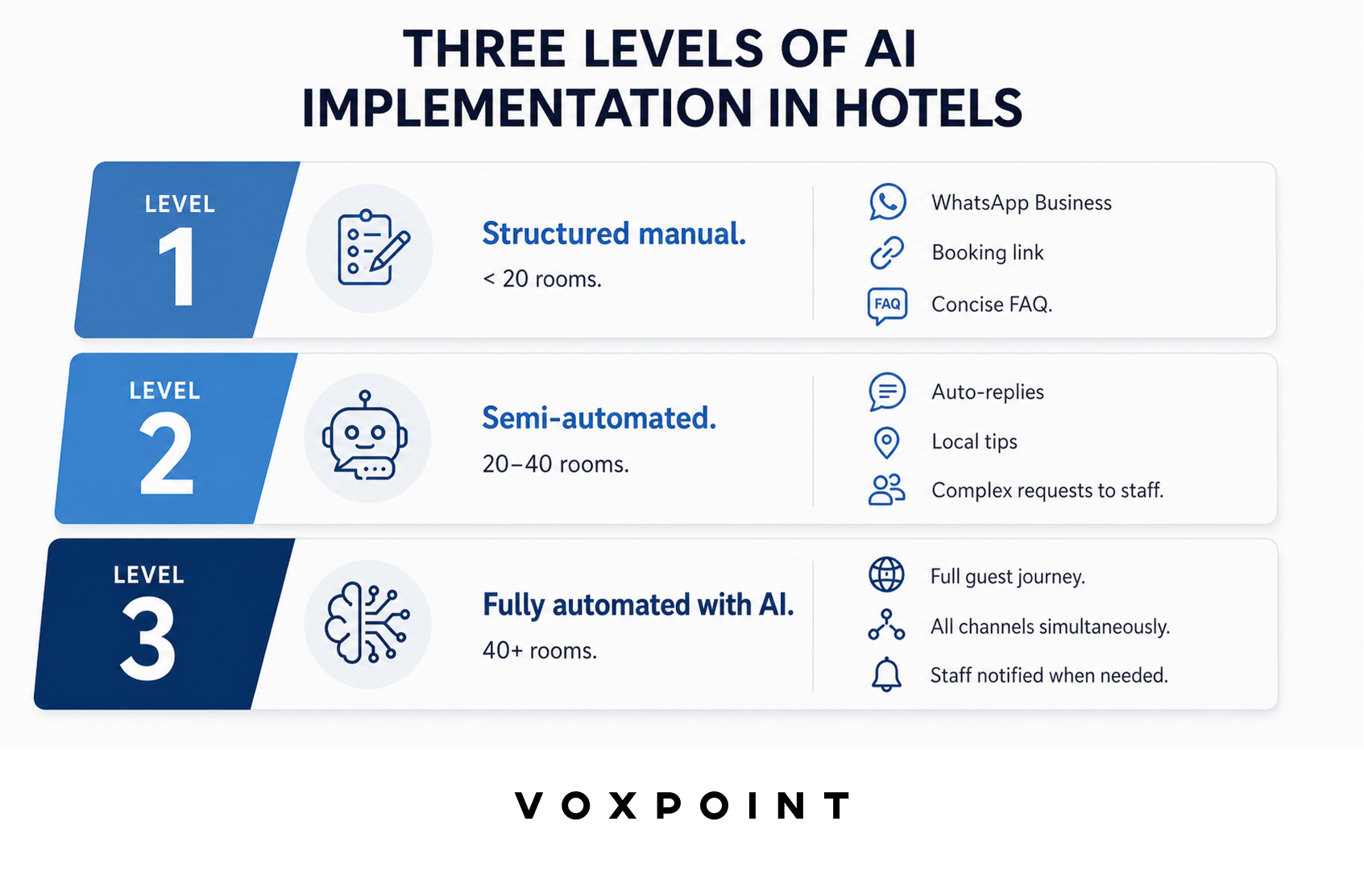
Level 1 — Structured manual (fewer than 20 rooms, low international volume)
Configure WhatsApp Business with an away message, a clear booking link, and a concise FAQ on your website. This reduces friction without requiring significant investment. Low cost, immediate to implement.
Level 2 — Semi-automated (20–40 rooms, or growing international demand)
Use automated responses for the most common inquiry types: availability, room types, breakfast, policies, local recommendations. Complex requests route to staff. This handles the majority of routine volume during peak season without requiring constant attention.
Level 3 — Fully automated with AI (40+ rooms, or high international volume)
An AI assistant trained on your property handles the full guest communication journey — from first inquiry to post-stay follow-up — across all channels. Staff are notified only when something requires their direct involvement. This is the approach that makes sense for properties operating at scale, or for smaller properties with strong international demand and limited team capacity during peak season.
Configure WhatsApp Business with an away message, a clear booking link, and a concise FAQ on your website. This reduces friction without requiring significant investment. Low cost, immediate to implement.
Level 2 — Semi-automated (20–40 rooms, or growing international demand)
Use automated responses for the most common inquiry types: availability, room types, breakfast, policies, local recommendations. Complex requests route to staff. This handles the majority of routine volume during peak season without requiring constant attention.
Level 3 — Fully automated with AI (40+ rooms, or high international volume)
An AI assistant trained on your property handles the full guest communication journey — from first inquiry to post-stay follow-up — across all channels. Staff are notified only when something requires their direct involvement. This is the approach that makes sense for properties operating at scale, or for smaller properties with strong international demand and limited team capacity during peak season.
What the assistant needs to know
A well-configured assistant for a boutique hotel or B&B needs:
— Real-time availability — connected to your PMS or booking calendar, so it never confirms a room that isn't free
— Your room types and rates — including seasonal pricing, special packages, upgrade options
— Your services and policies — breakfast times, check-in and check-out windows, cancellation terms, pet policy, parking
— Local knowledge — restaurant recommendations, transport options, local attractions, what's worth visiting in your specific area
— Your tone — a design hotel in Milan and a family-run agriturismo in Umbria communicate differently; the assistant should reflect your identity
— An escalation path — when to hand off to a human: complaints, accessibility needs, large group requests, anything sensitive
— Real-time availability — connected to your PMS or booking calendar, so it never confirms a room that isn't free
— Your room types and rates — including seasonal pricing, special packages, upgrade options
— Your services and policies — breakfast times, check-in and check-out windows, cancellation terms, pet policy, parking
— Local knowledge — restaurant recommendations, transport options, local attractions, what's worth visiting in your specific area
— Your tone — a design hotel in Milan and a family-run agriturismo in Umbria communicate differently; the assistant should reflect your identity
— An escalation path — when to hand off to a human: complaints, accessibility needs, large group requests, anything sensitive

The bottom line
The boutique hotel and B&B segment is growing. International guests are arriving in record numbers. The direct booking channel remains the highest-value source of revenue.
The properties that convert more of their inquiries into bookings are not necessarily the ones with the most beautiful rooms or the best location. They are the ones that respond — consistently, quickly, in the guest's language — at any hour.
For a small team running a full-service property, that consistency is difficult to maintain manually. AI guest communication tools are one practical way to close that gap without adding headcount.
The properties that convert more of their inquiries into bookings are not necessarily the ones with the most beautiful rooms or the best location. They are the ones that respond — consistently, quickly, in the guest's language — at any hour.
For a small team running a full-service property, that consistency is difficult to maintain manually. AI guest communication tools are one practical way to close that gap without adding headcount.
Sources
- Eurostat — EU tourism nights at record 3.08 billion in 2025 (January 2026)
- Grand View Research — Europe Boutique Hotel Market Size & Outlook, 2025–2030
- SiteMinder — Hotel Booking Trends 2025 (February 2026), based on 135 million reservations
- Phocuswright — Travel Forward: Data, Insights and Trends for 2026 (December 2025)
- McKinsey & Skift — Remapping Travel with Agentic AI (September 2025)
- InsideSales.com & Kellogg School of Management — Lead Response Management Study